
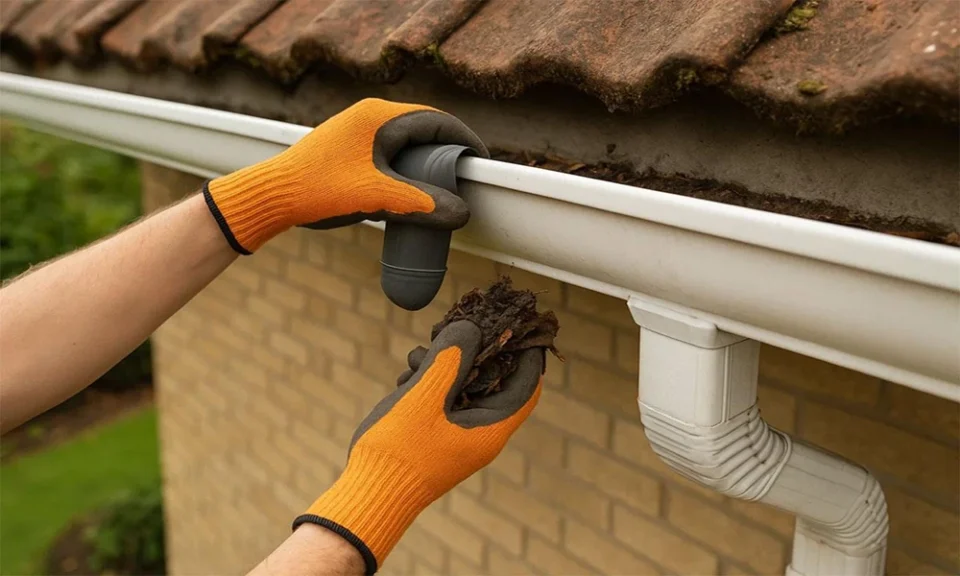
An overflowing gutter seems to have an obvious explanation: it must be full of leaves. Sometimes that is exactly the problem. But homeowners are often surprised when water continues spilling over the edge even though the visible part of the gutter looks relatively clean.
A gutter system depends on more than an open channel. Water must move along the gutter, reach the outlet, travel through the downspout, and discharge safely away from the house. A problem anywhere along that route can create overflow.
Understanding the less-visible causes can help homeowners decide whether they are dealing with routine debris buildup or a drainage problem that deserves closer attention.
A Clear-Looking Gutter Can Still Be Partially Blocked
Looking up from the ground does not reveal everything happening inside a gutter.
Leaves and larger debris are easy to see, but smaller material can collect along the bottom of the channel. Roof granules, seed pods, pine needles, twigs, and decomposing leaves can form dense material that slows water movement without completely filling the gutter.
The outlet where the gutter connects to the downspout is especially important. Even a relatively small accumulation in this area can restrict the amount of water that can leave the gutter during rainfall.
This is why visual appearance alone is not a reliable test of gutter performance. Watching the system during moderate rain can provide more useful information. Water should move toward the outlets rather than collecting in sections or spilling over the front edge.
The Downspout May Be the Real Source of the Problem
A homeowner can remove every visible leaf from the gutter and still experience overflow if the downspout is restricted.
Debris often moves through the gutter until it reaches a narrower transition point. Material can collect near the outlet, inside an elbow, or farther down the downspout where it cannot be seen from above.
Several warning signs may point toward a downspout problem. Water may spill over near one end of the gutter, drainage from the bottom of the downspout may appear weak during rain, or water may remain standing in the gutter after the storm has passed.
Clearing the gutter channel without checking the rest of the drainage path can therefore leave the original problem unresolved.
Homeowners who would rather have the entire system evaluated can compare local options using resources for gutter cleaning Noblesville while asking whether the service includes downspout clearing, leak checks, and inspection of drainage problems rather than simple surface debris removal.
The important question is not merely whether the gutter looks clean. It is whether water has an unobstructed path from the roof to its intended discharge point.
Improper Pitch Can Leave Water Standing
Gutters are installed with a slight slope so water can move toward a downspout. If part of the system shifts, loosens, or sags, that drainage path can change.
Instead of flowing toward the outlet, water may collect in a low section. During heavier rainfall, that area can fill faster than it drains and eventually overflow.
Standing water after rainfall is one clue worth investigating. It does not automatically mean the entire gutter needs replacement. A loose hanger, shifted section, or alignment issue may be contributing to the problem.
Homeowners should also pay attention to where overflow occurs. Repeated spilling from the same section may suggest something more specific than general debris buildup.
Too Much Roof Water May Be Reaching One Area
Not every overflow problem begins inside the gutter itself.
Roof design influences where rainwater travels. Valleys, intersecting roof sections, and large roof surfaces can concentrate significant amounts of water into a relatively small area. During intense rainfall, that concentrated flow may reach the gutter faster than the existing drainage configuration can handle it.
This can create a frustrating situation in which the gutters are clean and the downspouts are open, yet one location repeatedly spills over.
The useful question becomes whether the overflow occurs everywhere or primarily at one predictable point. A localized problem may indicate that water distribution, outlet placement, gutter alignment, or another system component deserves inspection.
Leaks and Loose Sections Can Imitate Overflow
Water running down the outside of a gutter is easy to interpret as overflow, but the water may actually be escaping through a seam, joint, end cap, or damaged area.
Loose gutters can create similar symptoms. If a section pulls away from the fascia, roof runoff may travel behind the gutter instead of entering the channel properly.
Observing exactly where water begins to escape can help distinguish between a capacity problem and a physical defect.
This distinction matters because repeatedly cleaning a damaged or poorly aligned gutter will not correct the underlying issue. Maintenance works best when cleaning and basic condition checks are treated as related parts of the same drainage system.
Pay Attention to Where Downspouts Discharge
Successful drainage does not end when water reaches the bottom of a downspout.
The system should move roof runoff away from areas where it can immediately collect beside the home. A disconnected extension, damaged lower section, or poorly positioned discharge point can create water-management problems even when everything above it is working correctly.
After rainfall, homeowners can walk around the property and look for obvious pooling near downspout outlets, disconnected components, erosion, or water traveling back toward the structure.
These observations can help identify whether the issue is occurring in the gutter, inside the downspout, or after the water leaves the system.
Conclusion
Gutter overflow is a symptom rather than a diagnosis. Visible leaves may be responsible, but hidden outlet blockages, clogged downspouts, standing water, alignment problems, concentrated roof runoff, leaks, and discharge issues can produce similar results.
Instead of judging the system only by how clean it looks, follow the entire path the water is supposed to take. Observe where water enters, where it slows down, where it escapes, and where it ultimately drains.
That simple approach can make gutter maintenance more effective and help homeowners identify small drainage problems before they become harder to address.
